Art of the American West
1830 – 1909
Missouri River portraits, Rocky Mountain panoramas and Remington bronzes - the West as nineteenth-century artists recorded and imagined it
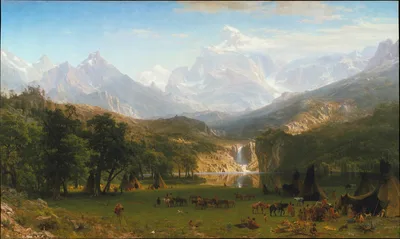 Lander's Peak, 1863
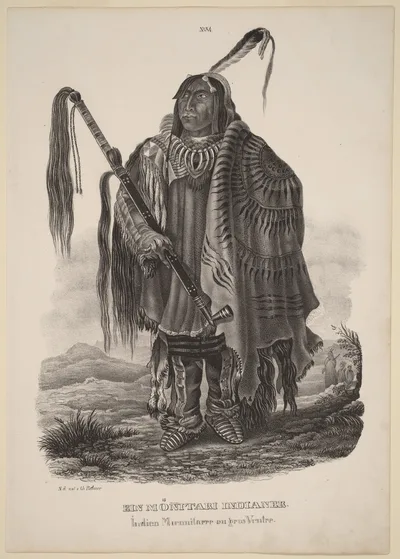
"Art of the American West" is not the name of a school with a manifesto. It is a convenient label for a body of nineteenth-century pictures made by artists who traveled - or claimed the authority of having traveled - west of the Mississippi, and for the much larger audience in New York, Washington, London and Paris that paid to look at them. The pictures in this archive run from the 1830s, when the upper Missouri River was fur-trade country reached by steamboat, to the first decade of the twentieth century, when Frederic Remington was casting cowboys and cavalrymen in bronze for collectors in the East. Much of what they show is Native American people and nations, painted by outsiders at a time when those nations were losing land, lives and sovereignty to the expanding United States. The images are invaluable historical records, and they are also arguments: about who belonged in the West, what it was for, and what its future would be.
George Catlin (1796-1872) is the reason so much of this archive is portraiture. A Pennsylvania lawyer who turned to painting, he went to St. Louis in 1830, where William Clark - governor of the Missouri Territory, superintendent of Indian affairs and co-leader of the 1804 expedition with Meriwether Lewis - became his mentor and took him to visit Plains nations. From that base Catlin made five trips between 1830 and 1836, visiting some fifty tribes according to the Smithsonian American Art Museum. In 1832 he traveled more than 2,000 miles up the Missouri to Fort Union, near today's North Dakota-Montana border, painting Mandan, Hidatsa, Crow, Assiniboine, Blackfeet, Cheyenne and other people at the trading posts and villages along the way. On that journey he proposed that the Plains, their people and their animals be protected in "a nation's Park," an idea the National Park Service now cites as an early statement of the national-park ideal.
Catlin returned east in 1838 and assembled his paintings and collected objects into a touring Indian Gallery, which he exhibited in Pittsburgh, Cincinnati and New York and hoped to sell to the federal government. Congress declined. In 1839 he took the gallery across the Atlantic to London, Brussels and Paris, where he often staged Native performers dancing - an early form of what later became the Wild West show. His book on the "manners, customs, and condition" of the North American Indians appeared in two volumes with about 300 engravings in 1841, followed by the North American Indian Portfolio of 1844. Debts forced him in 1852 to surrender the original gallery, then 607 paintings, to the Philadelphia industrialist Joseph Harrison; after Harrison's death his widow gave it to the Smithsonian in 1879, and it is now at the Smithsonian American Art Museum. Catlin spent his last two decades repainting his subjects from outline drawings, producing more than 400 works known as the "Cartoon Collection," and traveled through South and Central America between 1852 and 1857. The surviving cartoons went to the American Museum of Natural History in 1912, and in 1965 Paul Mellon gave 351 of them to the National Gallery of Art. Those oil-on-card paintings, dated 1861/1869 and 1854/1869 by the Gallery, make up most of this archive, together with Catlin's 1847/1848 series on the voyages of the French explorer La Salle.
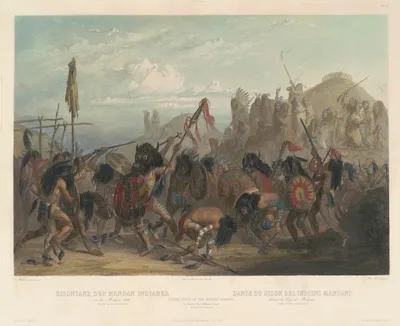
Catlin was not alone on the Missouri. In 1832 the German naturalist Prince Maximilian of Wied-Neuwied sailed for America with the young Swiss artist Karl Bodmer (1809-1893), whom he had hired to make a visual record of the journey. In April 1833 they left St. Louis upriver, reached Fort McKenzie near present-day Fort Benton, Montana, and wintered at Fort Clark beside the Mandan villages before returning the following spring. Bodmer's watercolors became 81 aquatint plates for Maximilian's Travels in the Interior of North America, published in German from 1839 and in English in 1843-44; this archive holds several of those plates, including the Bison-Dance of the Mandan Indians. The Mandan whom Catlin and Bodmer painted were soon devastated: a smallpox epidemic carried up the Missouri by steamboat in 1837 killed about nine in ten of them. Bodmer himself later settled in Barbizon, France, and spent the rest of his career etching deer, birds and forest scenes - work that also appears here, but is European rather than Western.
In 1837 the Baltimore painter Alfred Jacob Miller (1810-1874) was hired by the Scottish adventurer Sir William Drummond Stewart to record a hunting journey into the Rocky Mountains, traveling with American Fur Company men as far as Fort William and the Green River; his Western scenes later hung at Stewart's Murthly Castle in Scotland. The archive's single Miller, an election scene in Catonsville, Maryland, is a reminder that he spent most of his career at home.
After the Civil War the West became a landscape of spectacle. Albert Bierstadt (1830-1902), German-born and trained in Dusseldorf, joined Frederick W. Lander's survey party in 1859 and turned his sketches into The Rocky Mountains, Lander's Peak (1863), whose sale in 1865 for $25,000 was a record for an American painting. A seven-week stay in Yosemite Valley in 1863 supplied years of California subjects. Thomas Moran (1837-1926) traveled with Ferdinand V. Hayden's federally funded Yellowstone survey of 1871, a guest place arranged by the financier Jay Cooke; his sketches, with William Henry Jackson's photographs, were shown to members of Congress, and on March 1, 1872, President Ulysses S. Grant signed the act creating Yellowstone, the first national park. Bierstadt, Moran and painters such as Thomas Hill and William Keith are sometimes grouped as a "Rocky Mountain School."
The last chapter belongs to illustrators and sculptors of the cattle range and the frontier army. Frederic Remington (1861-1909) first went west to Montana in 1881, built his reputation drawing for Harper's Weekly, and in 1895 modeled The Bronco Buster, his first sculpture. Charles Schreyvogel (1861-1912) sketched at Buffalo Bill's Wild West show in Brooklyn in 1894 and won the National Academy of Design's Thomas B. Clarke Prize in 1901 for My Bunkie. Their Montana contemporary Charles M. Russell (1864-1926), "the cowboy artist," is not represented in these open-access collections.
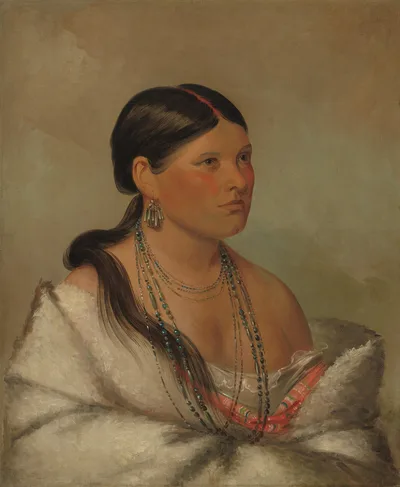
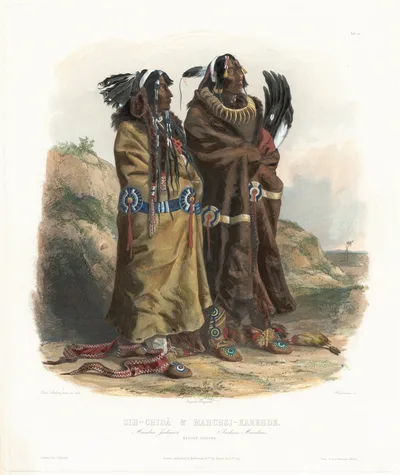
"A nation's Park, containing man and beast, in all the wild and freshness of their nature's beauty!"
— Art of the American West